What If You Could Try On Your New Smile? Meet 3D-Printed Veneers in Denver
Imagine looking in the mirror and seeing your new smile before you have committed to it.
Not a filtered photograph. Not a computer image floating on a screen. Not someone else’s before-and-after picture with a smile that happens to look nice on someone else’s face.
Your proposed smile. On you.
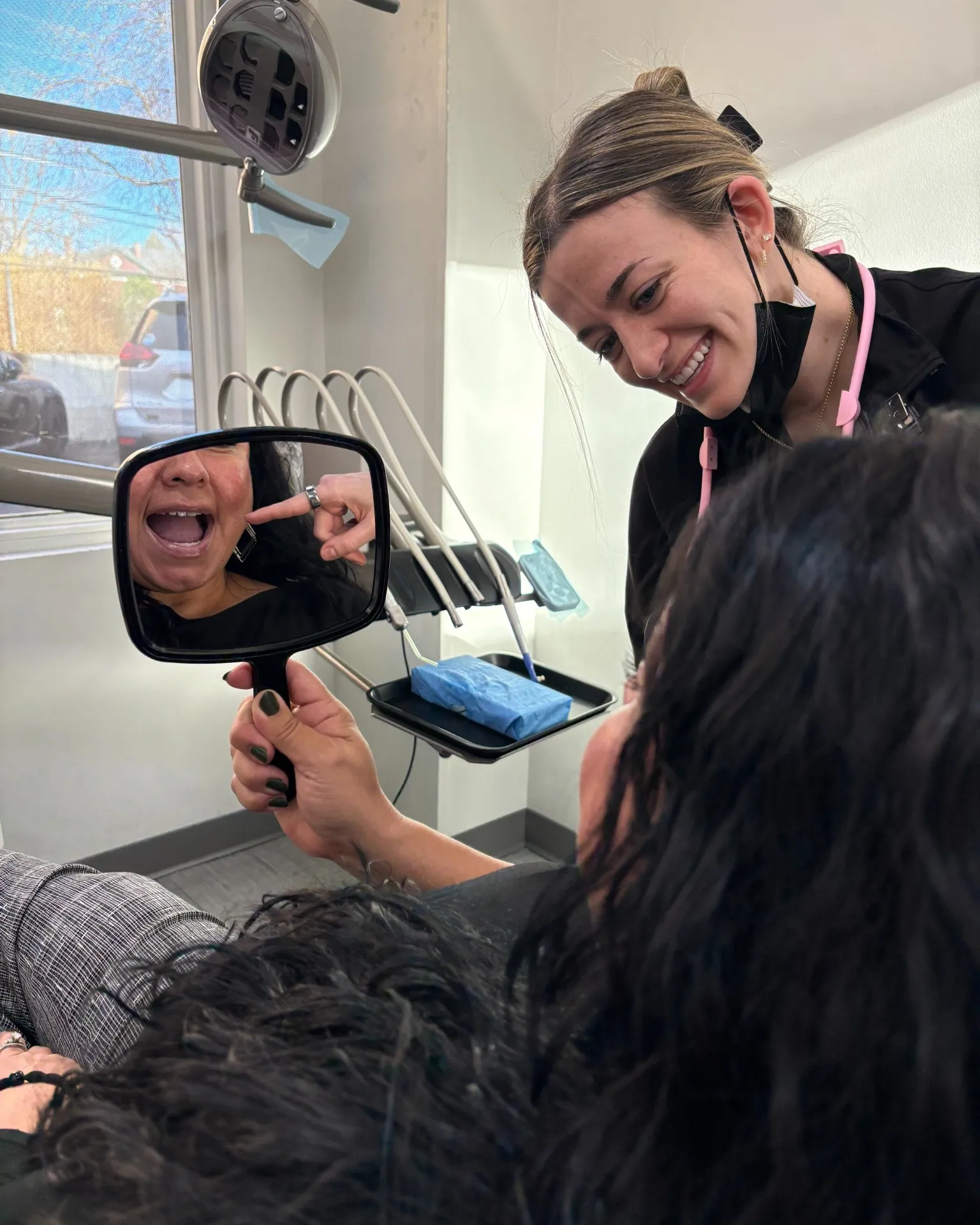
At The Denver Dentists & Implant Center, digital smile design and 3D printing allow us to create a physical veneer try-in based on the smile we are designing for you. You can place the preview over your teeth, look in the mirror, smile, talk, take photographs, and see how the new shapes and proportions interact with your actual face.
You can love it. You can ask for changes. You can decide the teeth feel a little too long, too square, too perfect, or not quite bold enough. You can say, “That looks beautiful, but it does not feel like me,” and we can listen before the final restorations are created.
That is a very different way to choose a smile.
A Smile Makeover You Get to Help Design
Veneers can change the shape, length, color, spacing, symmetry, and overall appearance of teeth. They can repair chips, close certain spaces, improve proportions, and transform teeth that have resisted whitening. But cosmetic dentistry is not simply a matter of making teeth straighter and whiter. The smile has to belong to the person wearing it.
Some patients want a dramatic transformation. They are ready for brighter teeth, a broader smile, and a visible before-and-after moment. Others want people to notice that they look fantastic without being able to identify exactly what changed. Both goals are valid, and both require more than selecting a generic tooth shape from a menu.
Dr. Kenneth Burson considers your facial proportions, lips, gumline, bite, tooth position, smile movement, and natural features. Then the proposed smile is created digitally. With 3D printing, that design can leave the screen and become something you can physically experience.
This is where the process gets fun. You are no longer trying to interpret dental vocabulary such as “slightly lengthen the laterals” while nodding as though that sentence has ever appeared in ordinary conversation. You can see the difference. You can compare. You can react instinctively.
Do you like a softer, more rounded shape or something more defined? Should the front teeth be a little shorter? Do you love the symmetry, or do you want to preserve more of the tiny variations that make a smile look natural? The veneer try-in turns those questions into a real conversation instead of a guessing game.
The Moment the Design Becomes Real
A digital smile preview is useful, but seeing teeth on a screen is different from seeing them framed by your own lips and face. Faces move. Smiles stretch, tilt, lift, and change when we laugh. Teeth that appear perfectly proportioned in a still image may feel different when you speak or see yourself from another angle.
With a 3D-printed veneer try-in, you can look at the design while your face is relaxed and while you smile fully. You can see how much tooth shows, whether the new length follows the curve of your lower lip, and how the shape changes your overall expression. Dr. Burson can evaluate the design in motion, and photographs from the try-in can help us refine it.
For many patients, this is the moment cosmetic treatment stops feeling abstract. They are no longer purchasing the promise of a future result. They are meeting that result early enough to have a voice in it.
The preview is not identical to the final veneers. The shade, translucency, surface finish, fit, and material may differ. It is a design prototype, not the finished performance. But it gives us something incredibly valuable: a shared visual language. Instead of saying, “I think I want natural, but also brighter, and maybe slightly bigger, although not big,” you can point to an actual tooth and tell us what you mean. Cosmetic dentistry has been waiting a long time for an easier way to translate “I’ll know it when I see it.”
Think of it as a test drive for your smile. You should know how it feels on your face before anyone starts discussing the extended warranty.
So What Are 3D-Printed Veneers?
Veneers are thin restorations placed over the front surfaces of teeth to improve their appearance. Traditional veneers are commonly made from porcelain or another ceramic material. Newer dental materials and printing technology also allow appropriately selected veneer restorations to be fabricated from biocompatible, ceramic-filled dental resin through a professional digital workflow.
The process begins with a digital scan rather than asking your smile to conform to a preselected template. The proposed teeth are designed for your mouth and 3D printed. The technology can be used to create the try-in, and in suitable cases it may also be used to create the final veneer restorations themselves. Those restorations are then professionally finished, evaluated, and bonded by the dentist.
These are not the removable snap-on products sold through online advertisements. Professional 3D-printed veneers are planned using your dental records, created from clinical materials, adjusted to your bite, and placed under the care of a dentist. The health of the teeth and gums underneath matters. So do fit, bonding, function, and maintenance.
The digital workflow can reduce some of the time and laboratory steps traditionally associated with veneers. It may also create a more accessible cosmetic option for selected patients. Most importantly, it gives us the flexibility to preview, refine, and reproduce a design without treating the first version as sacred simply because someone already made it.
3D-Printed Veneers or Porcelain Veneers?
The arrival of a new option does not make every previous option obsolete. Porcelain veneers remain an outstanding choice and may provide the best result for patients seeking highly individualized translucency, stain resistance, surface detail, and a long clinical history. For other patients, professionally fabricated 3D-printed veneers may offer an exciting combination of esthetics, digital customization, efficiency, and accessibility.
The materials are not identical, and we will not pretend they are. They differ in optical qualities, wear behavior, finishing, maintenance, cost, and long-term evidence. Dr. Burson will explain which choices are appropriate for your teeth and what you gain or trade with each one.
That honest comparison is part of what makes the try-in so useful. We are not trying to funnel every patient into the newest thing because the machine is shiny. We are using technology to expand your choices and make those choices easier to understand.
Some patients may be better served by porcelain veneers. Others may be great candidates for printed veneers. Sometimes whitening, clear aligners, or composite bonding can create the change a patient wants with less treatment. A structurally damaged tooth may need a crown instead. Cosmetic dentistry should not begin with the procedure we want to sell. It should begin with the smile you want to create and the healthiest way to get there.
Can I Try On Veneers Before My Teeth Are Prepared?
In many situations, a smile try-in may be possible before any tooth preparation, which can make the process feel far less intimidating. You can explore the idea of veneers without beginning with an irreversible step.
That does not mean every final case will be “no-prep.” Some teeth need reshaping so the veneers do not look bulky, interfere with the bite, or create difficult areas to clean. Tooth position, color, existing fillings, decay, available space, and the amount of change you want all affect preparation.
Dr. Burson’s goal is to preserve healthy enamel whenever possible while creating the space needed for a natural, durable result. Sometimes clear aligners can move teeth into better positions before veneers. Whitening may reduce the number of teeth that need treatment. Bonding may be enough for a small chip or contour change. The ability to try on a design helps us plan backward from the result instead of altering teeth first and solving the appearance later.
Conservative dentistry does not mean doing the least amount of treatment regardless of the outcome. It means doing what is necessary, preserving what is healthy, and avoiding changes that do not serve the final result.
Why This Is Different at The Denver Dentists
Owning a 3D printer is not the same as understanding smile design. Technology can reproduce a shape with remarkable accuracy, but it cannot decide whether that shape looks natural on your face. It cannot ask whether you still feel like yourself. It cannot balance a cosmetic goal against your bite, gum health, tooth structure, or long-term dental needs.
That part still requires a dentist with training, judgment, and an eye for detail.
Dr. Burson, MS, DDS, FAGD, has more than 15 years of experience and extensive advanced education through Kois, the Spear Institute, and the American Academy of Cosmetic Dentistry. His background in comprehensive, restorative, and cosmetic dentistry means he evaluates more than the front surface of a tooth. He considers how the entire smile looks, moves, and functions.
At The Denver Dentists & Implant Center, we combine that experience with digital scanning, smile design, CEREC, and in-office 3D printing. These tools allow us to turn ideas into something patients can see and touch. The point is not to fill the office with impressive equipment. The point is to remove some of the uncertainty from a highly personal decision.
Many offices can show you a digital picture of what veneers might look like. Our physical 3D-printed veneer try-in gives appropriately selected patients the opportunity to look in the mirror and experience the design on their own face. You can participate before the final smile is made, not simply react after it is finished.
That is how we want cosmetic dentistry to feel: exciting, collaborative, personal, and unmistakably yours.
If you have considered veneers but worried that they might look too big, too white, too artificial, or simply not like you, schedule a cosmetic consultation with Dr. Burson. We can evaluate your teeth, discuss printed and porcelain veneer options, and determine whether a digital smile design and 3D-printed try-in can let you preview the possibilities.
You should not have to choose a new smile from imagination alone. Come try it on.
Written by The Denver Dentists team. Reviewed for clinical accuracy by Dr. Kenneth Burson, MS, DDS, FAGD. Dr. Burson is the owner dentist at The Denver Dentists & Implant Center in Denver, Colorado. He focuses on comprehensive cosmetic and restorative dentistry, digital smile design, veneers, same-day CEREC restorations, implant dentistry, and long-term treatment planning.
Related Posts
Full Mouth Dental Implants in Denver: All-on-4, All-on-X, and Fixed Teeth Options
What If You Could Try On Your New Smile? Meet 3D-Printed Veneers in Denver
How Long Will My Dental Implant Last? A Denver Implant Dentist Explains